
Is Wrinkle Resistant the Same as Non-Iron?
No, wrinkle resistant and non-iron are not the same. While both are designed to reduce wrinkles and make fabrics easier to care for, non-iron fabrics offer a higher level of wrinkle recovery. In general, all non-iron fabrics are wrinkle resistant, but not all wrinkle-resistant fabrics are non-iron.
The difference lies in the finishing process and performance. Wrinkle-resistant fabrics help minimize creasing during wear and washing, while non-iron fabrics are engineered to maintain a smoother appearance with little or no ironing.
In this guide, we’ll explain what wrinkle resistant means, how wrinkle-resistant finishing works, how it compares with non-iron treatment, and which fabrics benefit most from this technology.
What Does Wrinkle Resistant Mean?
At its simplest, wrinkle resistant describes a fabric that has been chemically or physically treated to resist creasing during wear, washing, and drying. Such fabrics return to a smoother state with minimal effort—usually just hanging or a light shake after laundering.
For example, cotton is valued for its breathability and softness, but it wrinkles easily because its cellulose fibers absorb moisture and swell, creating internal stresses that form creases. A wrinkle resistant finish addresses this property by modifying how fibers behave, resulting in a fabric that:
- Requires less ironing
- Maintains a neater appearance for longer periods
- Offers convenience for everyday wear
For consumers, the appeal is clear: clothes look presentable straight from the dryer, and garments hold their shape throughout the day. In professional settings such as hospitality, healthcare, and corporate workwear, wrinkle resistant fabrics reduce maintenance costs and ensure a consistently polished appearance.
What Is Wrinkle Resistant Finishing?
Wrinkle resistant finishing is a chemical treatment applied primarily to cellulosic fibers such as cotton and linen to improve their crease recovery. It is also known as anti-crease, crease-resistant, easy-care, or durable press finishing.
The process works by altering the molecular structure of the fibers. Untreated cotton fibers contain cellulose molecules that are not bonded to one another. When water enters, the molecules swell and slide past each other, and as the fabric dries, these shifts lock in as wrinkles. A wrinkle resistant finish introduces cross-links between adjacent cellulose chains, which:
- Restrict fiber movement
- Allow the fabric to spring back to its original shape after bending or washing
Modern finishing is typically applied through a pad-dry-cure process:
- Fabric passes through a chemical bath containing cross-linking agents
- The fabric is dry
- Heat is applied to cure the finish
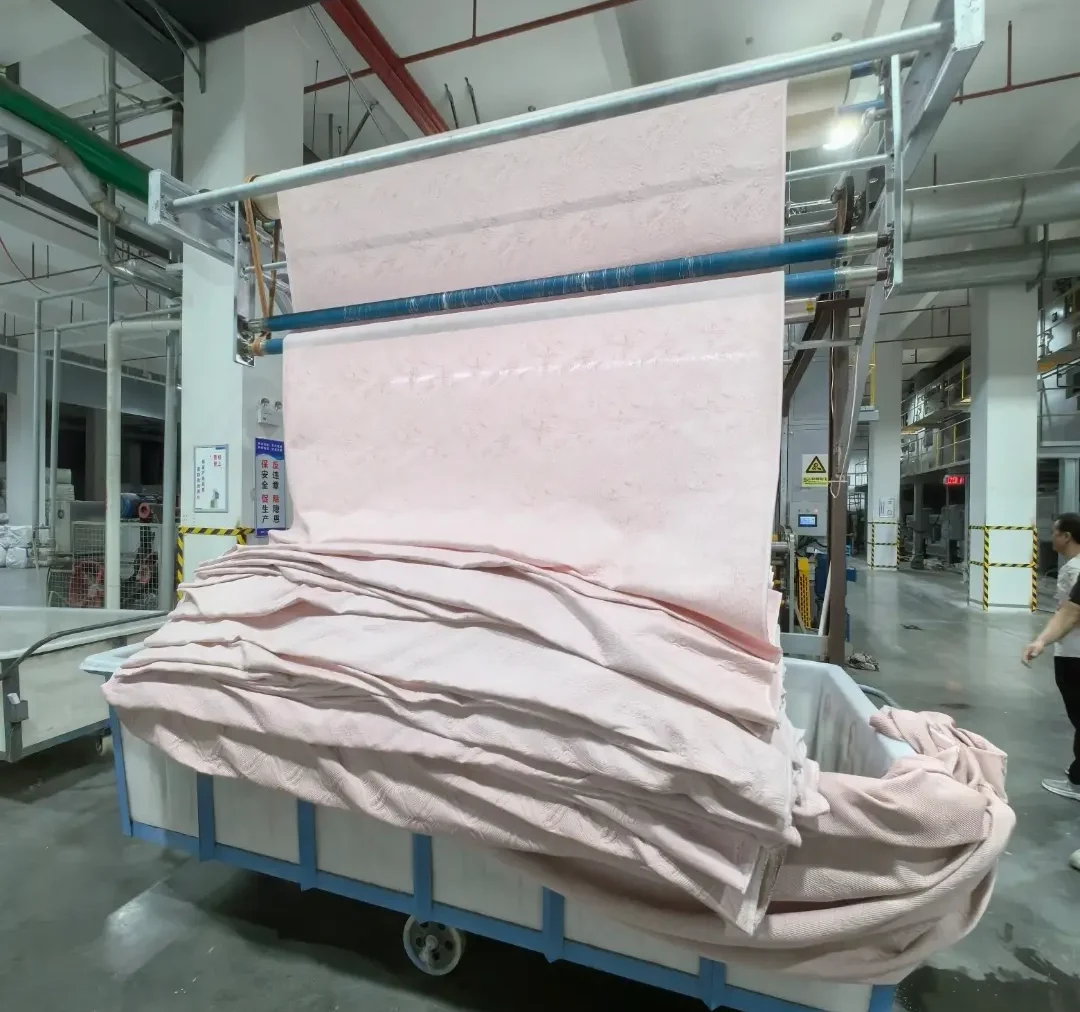
This method is standard for both woven and knitted fabrics, delivering reliable wrinkle resistance while preserving the fabric’s natural hand and appearance.
How Does Wrinkle Resistant Finishing Work?
The chemistry behind wrinkle resistant finishing is fascinating—and understanding it helps explain both the benefits and the trade-offs.
The Problem: Why Cotton Wrinkles
Cotton fibers are hydrophilic—they love water. They can absorb more than 10% of their weight in moisture. When you wash cotton, water molecules wedge themselves between the cellulose chains, breaking the hydrogen bonds that hold the fibers in place. The fibers swell. When the fabric dries, new hydrogen bonds form in random positions, freezing the fibers into whatever shape they happened to dry in. That shape is often wrinkled.
The Solution: Cross-Linking Resins
A wrinkle resistant finish introduces cross-linking agents—most commonly resins like DMDHEU (dimethyloldihydroxyethyleneurea)—that bond directly to the cellulose molecules. These cross-links act like tiny bridges, locking adjacent cellulose chains together. When the fabric is stressed (by bending, sitting, or washing), the cross-links prevent the chains from sliding past one another and force them to return to their original alignment.
The result: the fabric resists forming wrinkles in the first place and recovers more readily from those that do appear.
The Trade-Off: Strength vs. Smoothness
An unavoidable side effect of cellulosic cross-linking is a reduction in the fabric’s tensile and tear strength. The rigid cross-links that prevent wrinkling also make the fibers stiffer and more brittle, which can lower the fabric’s breaking strength by 20 to 25% compared to untreated cotton. This is the fundamental engineering trade-off: the more wrinkle resistant you want the fabric to be, the more strength you sacrifice.
However, newer formaldehyde-free technologies and advanced resin formulations have narrowed this gap significantly. Recent innovations using polymaleic acid chemistry produce wrinkle resistant performance comparable to traditional DMDHEU while better preserving fiber strength. Some modern treatments have demonstrated a durable press rating greater than 3.2 after 50 home launderings, while retaining 84% to 100% of original breaking strength.
Is Wrinkle Resistant the Same as Non-Iron?
This is the core question—and the answer matters for anyone sourcing fabric for uniforms, hospitality, or apparel.
| Aspect | Wrinkle Resistant | Non-Iron |
|---|---|---|
| Definition | Fabric treated to reduce wrinkling and improve crease recovery | A higher-performance finish that essentially eliminates wrinkling |
| Ironing required? | Yes, occasional pressing is needed for a crisp appearance | Minimal to none; the garment can be worn directly from the dryer |
| Finish application | Applied to fabric before garment construction (“pre-cure”) | Applied after garment construction (“post-cure”), locking in permanent creases |
| Smoothness rating (AATCC 124) | Typically 3.0–3.5 after washing | Typically 4.0–5.0 after washing |
| İçin en iyisi | Everyday apparel, bedding, casual wear | Dress shirts, formal wear, high-end uniforms |
Non-iron dress shirts generally deliver superior wrinkle-resisting performance compared to wrinkle resistant shirts. Non-iron treated fabrics tend to feel slightly stiffer and more resin-coated, while wrinkle resistant fabrics look and feel much closer to untreated materials.
Consumer Reports found that, when removed from the dryer, “no iron” garments appear the smoothest, followed by “wrinkle free,” then “easy care” which you’ll often find on blended cotton/poly fabrics.
In practice, a wrinkle resistant shirt will still benefit from a quick iron after washing if you need a sharp, professional look. A non-iron shirt can often be worn straight from the dryer—especially if you hang it promptly.
What Fabrics Can Be Made Wrinkle Resistant?
Almost any fabric can be treated for improved wrinkle resistance, but the results vary significantly by fiber type.
-
Cotton. The most common candidate for wrinkle resistant finishing. Cotton’s cellulose structure readily bonds with cross-linking resins, making it highly responsive to treatment. However, cotton also suffers the greatest strength loss from finishing.
-
Linen. Linen wrinkles even more easily than cotton and responds moderately well to wrinkle resistant treatments. However, linen’s natural stiffness means treated linen can feel quite harsh.
-
Silk. Recent research has demonstrated effective wrinkle resistant finishing on silk using chitosan-citric acid cross-linking. Treated silk achieved a crease recovery angle of 267.1°, with properties maintained after 20 washes.
-
Polyester and synthetics. Polyester is inherently wrinkle resistant due to its thermoplastic nature. It does not require chemical finishing—its molecular structure simply does not absorb water or form creases easily.
-
Blends (cotton/poly, Tencel, viscose). Blended fabrics often achieve good wrinkle resistance with less resin than 100% cotton, because the synthetic component already contributes some crease resistance. For example, higher polyester content in a blend improves durability and wrinkle resistance, while higher rayon (viscose) content may reduce it.
What Are the Benefits of Wrinkle Resistant Fabrics?
Wrinkle resistant fabrics have earned their place in both consumer and industrial markets for good reason.
1. Significant Time Savings
The primary benefit is reduced ironing time. For consumers, this means less household chore time. For uniform programs, it means faster turnaround between wears and lower labor costs for maintenance.
2. Professional Appearance Retention
In industries like hospitality, healthcare, and corporate services, appearance matters. Wrinkle resistant uniforms and linens maintain a crisp, professional look throughout the workday—even after sitting, bending, and moving.
3. Improved Shape Retention and Reduced Shrinkage
Cross-linking resins help fabrics keep their shape after repeated washing. Treated fabrics show less shrinkage and better dimensional stability than untreated equivalents.
4. Consumer Willingness to Pay a Premium
Wrinkle resistance and easy care consistently rank high in both awareness and perceived value among global consumers. Interestingly, consumers are willing to pay more for apparel with performance features like wrinkle resistance, but only when the smoothness level exceeds a threshold—roughly 4.0 on the AATCC smoothness scale. Below that, fewer than half of consumers see enough value to justify a higher price.
How Durable Is Wrinkle Resistant Finishing After Washing?
Durability is a critical concern for anyone investing in wrinkle resistant fabric. The finish does degrade over time, but modern technologies have significantly improved wash durability.
Standard Performance
Conventional wrinkle resistant finishes using DMDHEU resins typically maintain acceptable performance for 20 to 30 home launderings, after which the wrinkle recovery properties gradually decline.
High-Performance Technologies
Newer formulations dramatically extend this lifespan. One study found that after 50 cycles of home laundering, finished fabric still held a durable press rating greater than 3.2 (compared to 1.9 for untreated fabric), while retaining 84% to 100% of its breaking strength.
Technologies like Cotton Incorporated’s PUREPRESS™ and ENDURE™ have been engineered specifically to improve durability and maintain original fabric strength even after repeated home laundering.
Factors That Reduce Durability
Several factors accelerate finish degradation:
-
High-temperature washing (above 140°F/60°C)
-
Tumble drying on high heat
-
Chlorine bleach (destroys resin bonds)
-
Repeated harsh agitation
For maximum lifespan: wash in cool or warm water, use mild detergent without bleach, tumble dry on low or line dry, and remove promptly.
What Industries Commonly Use Wrinkle Resistant Fabrics?
Wrinkle resistant fabrics have become standard across multiple industries where appearance, efficiency, and durability intersect.
| Industry | Application | Why Wrinkle Resistant |
|---|---|---|
| Hospitality | Hotel bed linens, tablecloths, and staff uniforms | Professional presentation; reduced laundry labor costs |
| Healthcare | Scrubs, patient gowns, bed linens | Frequent high-temperature washing; needs to look clean and neat |
| Corporate workwear | Dress shirts, blouses, trousers | Consistent professional appearance; employee convenience |
| Military and public safety | Uniforms, dress attire | Demanding wear conditions require a sharp appearance with minimal maintenance |
| Food service | Chef coats, aprons, server uniforms | Heavy laundering schedules; heat and moisture exposure |
| Travel and hospitality apparel | Flight attendant and crew uniforms | Worn across long shifts in varied conditions; must look polished |
| Home textiles | Bed sheets, pillowcases, duvet covers | Consumer convenience; reduced ironing time |
Polycotton blends are particularly popular in workwear due to their balance of comfort, durability, and appearance retention. In healthcare settings, wrinkle resistant finishes also help maintain whiteness and shape after repeated high-temperature disinfecting washes.
How to Choose the Right Wrinkle Resistant Fabric for Your Application
Selecting the right wrinkle resistant fabric requires balancing several factors. Here is a decision framework.
Step 1: Define your performance requirements
-
Smoothness needed. If you need a crisp, formal appearance without ironing, look for non-iron finishes with AATCC smoothness ratings of 4.0 or higher.
-
Wash frequency. For daily laundering (healthcare, food service), prioritize finishes with proven durability beyond 50 washes.
-
Strength requirements. If the garment will face heavy abrasion or stress, seek lower-resin finishes or newer technologies that minimize strength loss.
Step 2: Choose your fiber content
-
100% cotton. Best breathability and comfort; highest strength loss from finishing; requires high-quality resin for durability.
-
Cotton/poly blends (65/35 or 80/20). Good balance of comfort, durability, and wrinkle resistance; less strength loss than pure cotton.
-
Polyester. Maximum wrinkle resistance and durability; lowest breathability; ideal for high-abrasion workwear.
-
Tencel/lyocell. Naturally smoother surface; responds well to finishing; good for premium applications.
Step 3: Check certifications and safety
If skin sensitivity is a concern, look for OEKO-TEX Standard 100 certified fabrics, which test for residual formaldehyde and other harmful substances. Formaldehyde-based resins—the industry standard for decades—can cause allergic contact dermatitis in some individuals. For applications involving direct and prolonged skin contact, formaldehyde-free finishes (such as polymaleic acid or citric acid-based systems) offer a safer alternative.
Step 4: Test before bulk purchase
Always request a sample. Wash and dry it using your intended process. Evaluate:
-
Smoothness after drying
-
Hand feel (softness vs. stiffness)
-
Strength (pull test along the seam)
-
Color retention after multiple washes
Step 5: Consider the total cost of ownership
A wrinkle resistant fabric may cost 15% to 25% more upfront than untreated fabric. However, when you factor in reduced ironing time, longer intervals between replacements, and lower laundry labor costs, the return on investment often justifies the premium. One industry analysis noted that manufacturing costs for wrinkle resistant apparel have been reduced by advanced chemistries, making the premium smaller than it once was.
Conclusion: Is Wrinkle Resistant Finishing Worth It?
Yes—with two caveats.
It saves time and cuts laundry costs. For hotels or hospitals, that alone pays off fast.
For home use? Depends how much you hate ironing. If you do, buy quality wrinkle resistant or non-iron. If you don’t mind a quick press, untreated cotton feels nicer.
New formaldehyde-free finishes are solving the old health concerns, and the strength loss is smaller than it used to be.
So no, it’s not a gimmick. Pick the right fabric for your job, and it works.
Lütfen çekinmeyin Bize ulaşın anytime with any questions or needs.