
Abstrakt
For bedding fabric buyers and product developers, the dyeing process is not a back-end production detail — it is a core specification decision that shapes color consistency, hand feel, production economics, and compatibility with downstream finishing operations such as sand-wash and enzyme softening.
Two methods dominate industrial bedding fabric production: pad dyeing and overflow dyeing. Each carries distinct mechanical logic, cost structures, and quality outcomes. Choosing the wrong process for your fabric type or target end-use can result in color deviation, compromised softness, elevated re-dyeing rates, or incompatibility with finishing treatments your product requires.
This article provides a structured, side-by-side technical and commercial comparison of both processes. It is written for procurement managers, textile product developers, and sourcing teams who need to make defensible, specification-level decisions — not just surface-level supplier conversations. Whether you are scaling a solid-color microfiber comforter program or developing a premium enzyme-softened woven bedsheet collection, the process selection framework outlined here will help you align production method with product intent from the outset.
1. Understanding the Two Processes: How They Work
1.1 Pad Dyeing: Mechanism & Process Flow
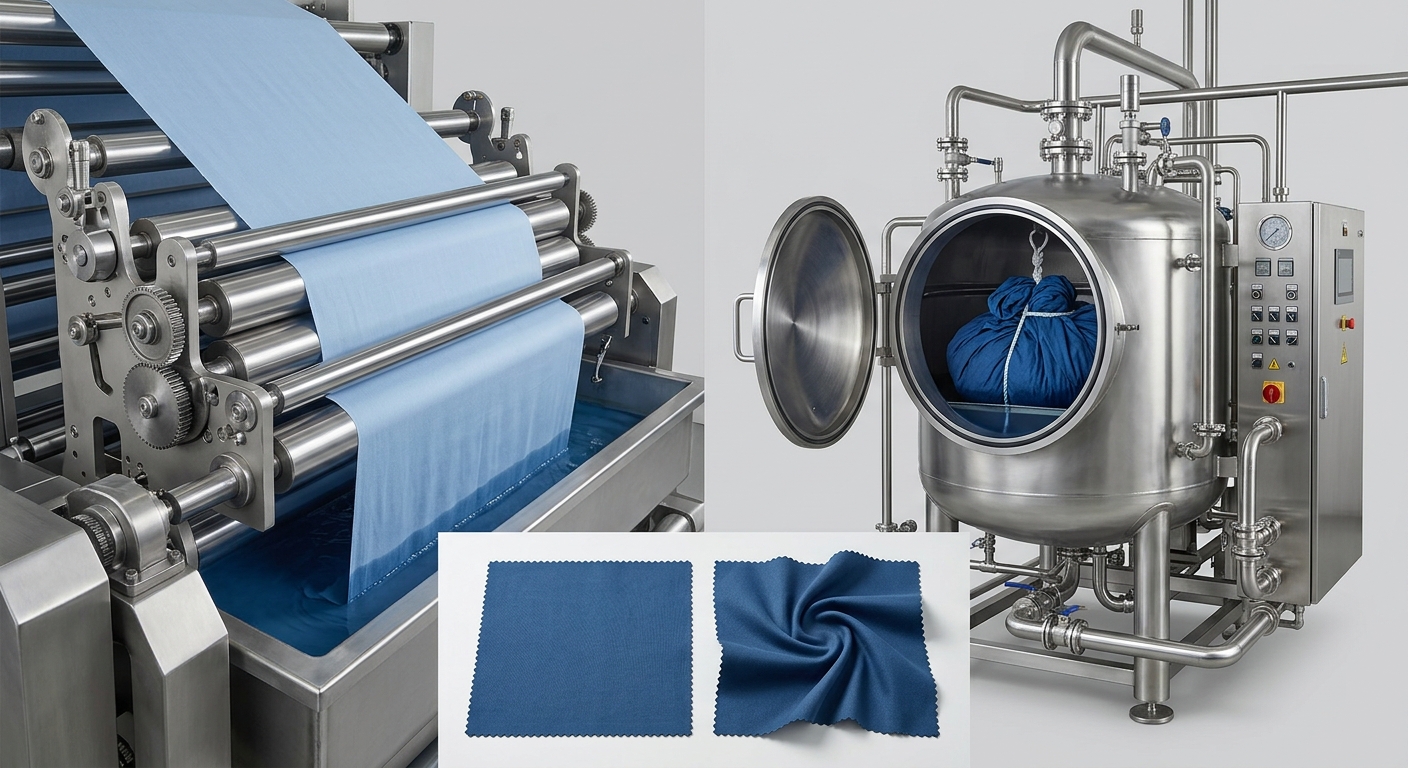
Pad dyeing is a continuous, open-width dyeing process. Fabric is fed in flat form through a dye bath trough where it is fully impregnated with dye liquor. It then passes through a set of squeeze rollers — the “pad” — which controls dye pick-up by applying calibrated pressure, typically achieving a wet pick-up rate of 60–80%. The impregnated fabric is then passed through a steamer or thermosol fixation unit, where heat drives dye migration into the fiber structure.
The process is inherently high-throughput. A single continuous pad range can process thousands of meters per hour, making it well-suited for large-volume, solid-color production runs. Because the fabric runs flat and under controlled tension, dimensional stability is preserved throughout — a critical advantage for woven constructions where skew and shrinkage tolerances are tight.
Dye fixation chemistry in pad dyeing is typically reactive (for cotton) or disperse (for polyester), and the process requires precise control of pad pressure uniformity, dye bath concentration, and fixation temperature to maintain shade consistency across the full fabric width. Edge-to-center shade variation (left-center-right, or LCR) is the primary quality risk and must be monitored with inline spectrophotometry on well-managed production lines.
1.2 Overflow Dyeing: Mechanism & Process Flow
Overflow dyeing is a batch-based, rope-form process. Fabric is loaded into a pressurized vessel in a continuous rope configuration. The dye liquor is circulated at high velocity through a jet nozzle, which propels the fabric rope through the machine while simultaneously pumping dye solution around and through the fabric. The mechanical action of the jet combined with the chemical affinity of the dye achieves deep, full-penetration color saturation.
Because the fabric moves freely in rope form — tumbling, folding, and circulating continuously — the process naturally imparts a degree of mechanical softening and surface texture development. This is both a feature and a constraint: overflow dyeing produces excellent color depth and a characteristically soft, slightly relaxed hand feel, but it also introduces the potential for rope crease marks, fabric elongation, and surface pilling if machine parameters are not carefully managed.
Batch sizes in overflow dyeing are bounded by machine capacity — typically 100 to 500 kg per run depending on vessel size. This makes the process inherently more flexible for smaller orders, but less efficient per meter at very high volumes compared to continuous pad dyeing.
2. Performance Comparison: Color, Hand Feel & Finishing Compatibility
2.1 Color Consistency & Penetration Depth
Pad dyeing delivers high surface uniformity across wide fabric widths, making it the preferred method where tight color repeatability across production lots is required. In well-controlled pad dyeing operations, inter-lot ΔE values of ≤1.0 (CIE Lab) are achievable for solid colors — a standard that matters significantly for bedding programs with multi-SKU colorways that must match across seasons or reorders.
However, pad dyeing applies dye primarily from the surface inward. For heavier or more densely woven constructions, full cross-sectional penetration may be incomplete, which can affect color depth and rub fastness ratings — particularly in dark shades.
Overflow dyeing, by contrast, achieves full-penetration dye saturation through continuous mechanical and hydraulic agitation. Color depth (K/S values) is consistently higher for equivalent dye concentrations. Wash fastness ratings of 4–5 (ISO 105-C06) and dry rub fastness of 4+ (ISO 105-X12) are standard outcomes. The trade-off is inter-batch shade variation: because each vessel run is an independent batch, matching shade across multiple lots requires careful dye recipe management and rigorous lab-to-bulk correlation protocols.
For bedding end-use, the practical implication is clear: pad dyeing suits programs requiring exact shade repeatability at scale; overflow dyeing suits programs prioritizing color richness and depth over lot-to-lot precision.
2.2 Compatibility with Sand-Wash & Enzyme Softening Finishing
The interaction between dyeing method and downstream finishing is a frequently underestimated specification variable. For products incorporating sand-wash finishing, pad-dyed open-width fabrics enter the process in a dimensionally stable, flat state. The abrasive action of sand-wash creates a consistent surface texture without the pre-existing mechanical stress that rope-dyed fabric carries. The result is a more uniform, controllable surface finish — particularly important for woven microfiber and polyester-cotton constructions where surface uniformity is a premium attribute.
For Enzym-Weichmachungs-Finish, overflow-dyed fabrics present a natural advantage. The rope-form mechanical action during dyeing partially opens the fiber surface and relaxes the yarn structure, increasing the accessible surface area for cellulase or protease enzyme action. This translates to more efficient enzyme uptake, faster softening cycle times, and a more pronounced tactile result — the characteristic “peach skin” or velvety hand feel associated with high-quality enzyme-softened bedding.
Pad-dyed fabrics can undergo enzyme softening effectively, but may require longer treatment cycles or higher enzyme concentrations to achieve equivalent softness levels, marginally increasing processing cost.
Key Parameter Comparison: Pad Dyeing vs Overflow Dyeing
| Dimension | Pad-Färbung | Überlauffärbung |
|---|---|---|
| Fabric Form | Open-width (flat) | Rope form |
| Applicable Fabric Weight | 80–300 gsm wovens | 100–400 gsm knits & wovens |
| Color Fastness — Wash (ISO 105-C06) | 3.5–4.5 | 4–5 |
| Color Fastness — Dry Rub (ISO 105-X12) | 3.5–4 | 4–4.5 |
| Water & Energy Consumption | Lower (liquor ratio 1:0.5–1) | Higher (liquor ratio 1:8–15) |
| MOQ / Batch Size | 3,000–10,000 m minimum | 500–3,000 m per batch |
| Lead Time (bulk) | 7–12 days | 10–18 days |
| Sand-Wash Compatibility | Ausgezeichnet | Good (requires tension control) |
| Enzyme Softening Compatibility | Gut | Ausgezeichnet |
| Relative Unit Cost (dyeing only) | Lower at high volume | Higher per meter; lower per batch |
3. Applicable Fabric Types & Bedding Product Scenarios
3.1 When to Choose Pad Dyeing for Bedding
Pad dyeing is the optimal choice for woven flat fabrics — particularly polyester-cotton blends, 100% polyester microfiber, and plain or twill-woven cotton constructions in the 100–250 gsm range. Its continuous processing logic delivers the lowest per-meter dyeing cost at volumes above 5,000 meters per color, making it the standard method for high-volume solid-color bedding SKUs: fitted sheets, duvet covers, pillowcases, and flat sheets in retail replenishment programs.
The process is also preferred when color matching across multiple fabric components within a single bedding set is required. Because pad dyeing parameters can be precisely replicated, achieving consistent shade between a woven duvet cover and a coordinating pillowcase — even if run at different times — is more reliable than with batch overflow processes.
For buyers sourcing bedding programs with 10+ colorways, seasonal reorders, or private-label programs requiring tight shade standards, pad dyeing provides the process control infrastructure that supports long-term color program management.
3.2 When to Choose Overflow Dyeing for Bedding
Overflow dyeing is the preferred method for knitted fabrics, jersey constructions, and any fabric where softness and color depth are primary product attributes. It is also the standard process for heavier woven fabrics — brushed cotton, flannel, or structured jacquard constructions — where full dye penetration through a dense yarn structure is required to achieve acceptable rub fastness.
For product developers working on premium enzyme-softened bedding lines, overflow dyeing creates the ideal fiber condition for downstream softening treatments. The combination of overflow dyeing followed by enzyme softening finishing produces the deep color saturation and exceptional tactile softness that positions products in the mid-to-premium retail segment.
Overflow dyeing is also the practical choice for small-batch development and sampling programs, where flexibility and minimum order quantity constraints favor batch processing over continuous line setup.
4. Cost, MOQ & Supply Chain Considerations
4.1 Total Cost of Ownership Analysis
Unit cost comparisons between pad and overflow dyeing are only meaningful when evaluated across the full production cycle. Pad dyeing carries lower water and energy consumption — liquor ratios of 1:0.5 to 1:1 versus 1:8 to 1:15 for overflow — which directly reduces utility costs and wastewater treatment load. At volumes above 5,000 meters per run, pad dyeing’s continuous throughput delivers a 15–30% lower dyeing cost per meter compared to equivalent overflow batch production.
However, pad dyeing setup costs are higher: color changes require line flushing, pad roller cleaning, and re-standardization, which creates a cost penalty for short runs or frequent color switching. Re-dyeing risk is also concentrated differently — a shade deviation in pad dyeing can affect an entire continuous run before detection, while overflow batch errors are contained within a single vessel load.
Overflow dyeing’s higher per-meter cost is partially offset by lower rework rates on complex shades, better first-pass yield on dark or saturated colors, and elimination of the LCR shade variation risk that requires inline monitoring investment in pad dyeing operations.
4.2 Lead Time, Flexibility & Supplier Qualification
Overflow dyeing offers greater scheduling flexibility for development and small-batch orders — most capable suppliers can turn around a 500-meter sample batch in 10–14 days. Pad dyeing lead times are typically shorter for bulk production once a color is approved, but sampling lead times can be longer due to line scheduling constraints.
When qualifying a dyeing supplier, buyers should verify: spectrophotometric color management capability (inline for pad; lab-to-bulk correlation protocol for overflow), wastewater treatment compliance, documented process parameters for sand-wash and enzyme finishing compatibility, and inter-lot ΔE performance data from existing production records.
FAQ
Q1: Can the same bedding fabric be processed with both pad dyeing and overflow dyeing for A/B comparison sampling?
Yes, and it is a recommended practice for new fabric development. Running identical greige fabric through both processes on the same color target reveals differences in shade depth, hand feel, and finishing response before committing to a production method. Most experienced dyeing suppliers can accommodate dual-process sampling on request, though minimum quantities and lead times will apply to each method independently.
Q2: How does the choice of dyeing process affect the final softness after enzyme softening finishing?
Overflow-dyed fabrics typically achieve a more pronounced softness result from enzyme treatment due to the mechanical fiber opening that occurs during rope-form dyeing. Pad-dyed fabrics can reach equivalent softness levels but may require adjusted enzyme concentration or extended treatment time. For products where tactile softness is a primary selling attribute, overflow dyeing followed by enzyme softening is the recommended process sequence.
Q3: What minimum order quantities are typically required for each dyeing method?
Overflow dyeing is accessible at lower MOQs — typically 500–1,500 meters per color per fabric construction. Pad dyeing is economically viable from approximately 3,000–5,000 meters per color, with optimal cost efficiency above 8,000 meters. For small-batch bedding development programs or initial market testing, overflow dyeing provides the lower entry threshold without requiring full-scale production commitment.
Schlussfolgerung
The choice between pad dyeing and overflow dyeing for bedding fabric is not a matter of one process being superior — it is a matter of alignment between process mechanics and product requirements. Pad dyeing delivers cost efficiency, color repeatability, and dimensional stability at scale for woven flat fabrics in high-volume solid-color programs. Overflow dyeing delivers color depth, softness, and flexibility for knitted constructions, premium enzyme-softened products, and small-batch development needs.
For sourcing teams, the key decision criteria are: fabric construction and weight, target hand feel and color depth, downstream finishing requirements (particularly sand-wash and enzyme softening compatibility), volume per color, and total cost of ownership across the full production cycle — not dyeing unit cost alone.
Engaging a supplier with documented capability in both processes, and the technical team to advise on process-finishing interaction, is the most reliable path to first-pass quality and long-term program consistency.